
Chapter Text
Timeline
Compiled by DEM2, Hagar, grimorie and offkilter
- 1979 - Iranian Islamic revolution, Shaw’s mother(-to-be) flees the country with help of Shaw’s father(-to-be) (Canon reference: s03e18. Recounted by Shaw. -Hagar)
- ~1981- Shaw was born. (This and all age references calculated from canonical anchors. -grimorie) (And restricted by the need to fit in everything Shaw’s accomplished. -Hagar)
- 1988 - Shaw’s father brought her for a Philadelphia Eagles vs Houston Oilers game (5~7 years old) (Canon reference: s03e16 Mors Praematura. "Root at knifepoint talks to Shaw about October 2, 1988 being a road trip of importance" -offkilter)
- 1993 - Shaw’s father killed (10~12 years old.) (Canon reference: s03e05 Разговор | Razgorov.Screen capture -offkilter. "She was “about [Gen’s] age” in 1993. Genrika was ten. The actor playing young Sameen was about 11 (not yet 12)." -DEM2)
- ~1999 - Graduation from school/undergrad (To make the timeline fit, we're assuming Shaw was in an excellence program that allowed her to graduate with a baccalaureate degree at the time she would've otherwise graduated high school. Information on these programs supplied by DEM2)
- 1999-2001 - Active Service. (Shaw’s USMC tattoo, screen capture; Shaw’s father’s USMC tattoo,screen capture. -grimorie) (During this period, Shaw would’ve had to have been deployed and done something beyond exceptional and impressive, or the ISA wouldn’t have been interested in her later. -Hagar)
- 2001-2004 - Medical School. (Shaw in Active Reserve, i.e. one weekend a month. -Hagar.)
- 2004-2005 - Shaw in residency (Emergency Medicine); (22 ~ 24 years old) (Reference: s03e10 Devil’s Share.Screen capture -offkilter) (Licensure can typically be obtained within 1yr, so Shaw’s probably licensed to practice. However, she did not complete her residency - an Emegency Medicine residency is 4yr long. -Hagar)
- 2005-2010 - ISA Training (Assuming 4yr for training + 1yr supervised missions, based on public data for equivalent roles at other agencies. -Hagar)
- 2010 - Shaw on her first Northern Lights solo (27~29 years old) (Canon reference: s03e16 RAM.) (Estimated to be her first solo based on comments from the ep + real-life standards. -Hagar / Estimated: November - December per RAM, given Nathan Ingram’s date of passing. -DEM2)
- 2013 - Shaw (and, possibly Cole) stopped a radiological bomb from exploding near a country day school in Georgetown where [Senior Intelligence Adviser to the President,] Manuel Rivera’s children studied. (Canon reference: Recounted and confirmed by Control in s03e22 A House Divided).
- 2013 - Joined up with Machine Gang. (30~32 years old) (Canon reference: s02e16 Relevance)
- 2014 - 31~33 years old


Intelligence 101
Compiled by Hagar
This section is intended to introduce basic concepts in intelligence. It’s compiled from reliable, public-accessible sources (primarily the Encyclopedia of Espionage ), and geared towards terms and concepts that are relevant for Person of Interest.
The intelligence cycle. As defined to the US, the intelligence cycle has five steps: planning, collection, processing, production and dissemination. “Planning” is the policy step of deciding which intelligence is required and at what priority. Obtaining this information is “Collection”, and comprises most actions colloquially recognized as “spying”. “Processing” prepares raw data to be assessed in “Production”. Finally, the prepared intelligence product is disseminated to the appropriate consumers (including but not limited to operations groups and policy makers), and the cycle begins again.
Let us consider an example: a recording made from a wiretap. Installing the wiretap and obtaining the recording are collection. The recording will then need to be processed: transcribed and possibly translated. The ready, annotated transcription will then be the subject of analysis. (Importantly, “analysis” is always of a body of products in context, and not of a single one.) Finally, the products of analysis will be disseminated to the consumers.
Types of intelligence. Types of intelligence are determined by the type of the source. In the example above, the source was a wiretap; this kind of information is known as “communication intelligence”, or COMINT. COMINT is one kind of signal intelligence (SIGINT). The other kind of SIGINT is electronic intelligence (ELINT). Signals from a radar system are an example of ELINT content. A satellite photo is an example of visual intelligence (VISINT). Open-Source intelligence (OSINT) sifts through publically available sources to extract usable intelligence. Lastly, intelligence collected from human sources is referred to as HUMINT.
In the context of Person of Interest, much of Finch’s activities towards handling the numbers are SIGINT and OSINT collection, processing and production (Reese being the sole consumer for Finch-produced intelligence).
The Machine serves in all roles: it collects intelligence from various sources (OSINT, SIGINT and VISINT), it analyzes this raw intelligence, and it disseminates the numbers as its products. Note that the numbers then serve as a planning direction to those who receive them: Finch’s collection effort is guided by the Machine’s product.
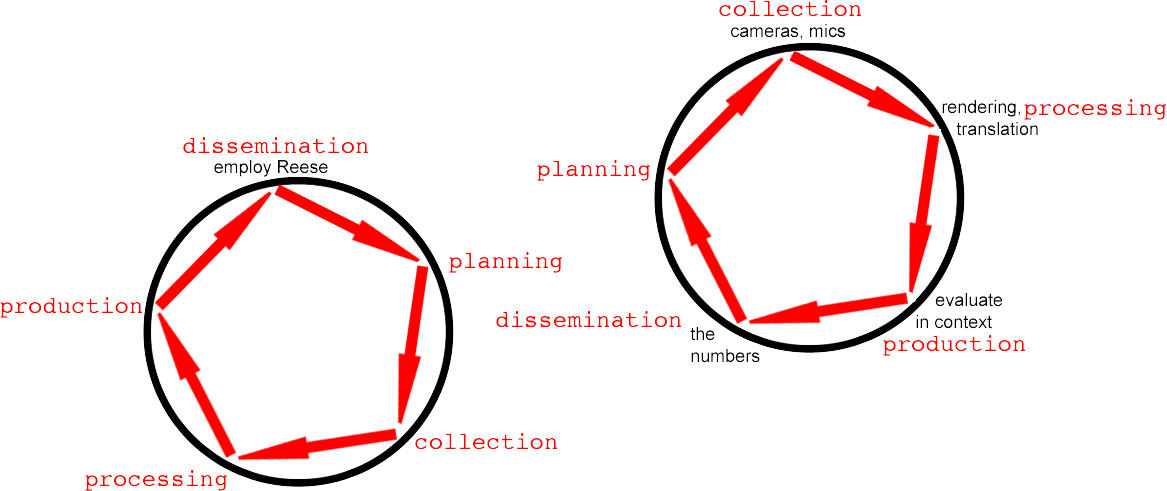
Figure: an illustration of the Machine's internal cycle, the Irrelevants cycle and the way the Irrelevants cycle is originated from the Machine cycle. Not depicted is the Relevants cycle, which originates off the same point in the Machine cycle.
Intelligence officers and agents. An “officer” is a person employed by an intelligence agency. The use of the word “officer” does not imply a military status; CIA HUMINT operators are known as “case officers”. The human source used by a case officer is an “intelligence agent”. Repeat: an officer is employed by an agency, an agent is used by an officer. (And yes, the FBI’s “special” terminology is, well, special.)
Covert operations. Any and all intelligence-related operations, carried out in silence: they are not meant to be publicly known. Covert operations are typically carried out in foreign countries, but can also be executed domestically. They may be carried out by intelligence officers, by military forces or in collaboration. Covert operations may be for many purposes, including but not limited to intelligence collection (e.g. planting a wiretap or otherwise “bugging” a target, obtaining copies of documents, HUMINT handling) or more classically offensive purposes (kidnapping, assassination).
Special Operations Forces (SOF). US Military units which may be engaged in covert ops. Includes (non-exhaustive): Army Special Forces (the “Green Berets”, 20 groups of 3 battalions each - this is a huge cluster of units, not a single unit, and it’s a huge-ass cluster at that), Delta Force, Army Rangers, Navy SEALs (in particular DEVGRU, otherwise known as Team Six), Marines Corps Force Recon and various Air Force Special Forces units.
Deniable assets. Officers and agents whose allegiance will be denied by the agency operating them. Uniformed soldiers are ordinarily not deniable assets, but SOF operatives may sometimes be. Non-uniformed operatives and officers pretty much always are. Deniable assets who had been caught or otherwise compromised are on their own and cannot expect a rescue.
Sameen Shaw & The US Marine Corps
by offkilter
The Marines get all their medical support from the Navy. I’m having a hard time seeing Shaw as an enlisted recruit with her level of education, no matter if she were planning on being a doctor or not, though that is not completely off the table. I wouldn’t be the slightest bit shocked if she were a line officer.
(“In the United States Armed Forces , the term line officer or officer of the line refers to a U.S. Navy , U.S. Marine , U.S. Air Force or U.S. Coast Guard commissioned officer who exercises general command authority and is eligible for operational command positions, as opposed to officers who normally exercise authority within a specialty. Officers who are not line officers are those whose primary duties are in non-combat specialties including chaplains , attorneys (only U.S. Army and U.S. Navy) , supply and medical services . A line officer may hold authority over a non-line officer of higher rank by the nature of their job, but is otherwise expected to observe normal customs and courtesies outside that role.” - Wikipedia)
Heck, it’s ENTIRELY possible she got through med school on a military scholarship, and if she “washed out” as a doctor (though there’s NO WAY they’d really kick her for the things they said in the flashback), she’d still probably owe time and/or money to the military for her training, and might have chosen to discharge that debt via the Marines instead of Navy (which would be a more natural course—or just paying back literally with money). [Editor’s note: this scenario assumed a different timeline than the above. In this scenario, Shaw completed her MD immediately after her undergraduate degree, but postponed her residency until after her active duty period.] Had she commissioned as an MD, she’d have gone through Officer Indoctrination (jokingly called Fork & Knife school as it teaches you basic military orientation) as a newly minted Navy doc and would already be a Naval staff corps officer. In order to become a Marine officer she’d probably have had to go to Officer Candidate School to complete a 10 week Officer Candidate Course and then onto The Basic School for 26 weeks to learn how to lead people into combat.
If she were kicking butt and taking names in deployment, I could see her getting the attention of some interested parties.
If she were an enlisted recruit, she’d have gone to Parris Island for boot. Parris Island, 4th Battalion, is the ONLY place female enlisted Marine recruits train, so no “Hollywood Marine Camp” for her; the Marine Corps is only 5% women, so they consolidate. Some helpful links:
- Boot Timeline; Basic is 13 weeks.
- Wiki article about Marine Corp Recruit Training here.
- Post graduation, wiki states: “After ten days of leave, Marines will attend the School of Infantry (SOI); east coast graduates will attend SOI East at Camp Geiger, while west coast graduates will return to Camp Pendleton for SOI West. Non-infantry Marines will attend a course called Marine Combat Training for 29 days, then proceed to the appropriate school for their Military Occupational Specialty (which vary in length). Infantry Marines attend the Infantry Training Battalion for 59 days. Then these newly trained Marines are assigned to their first unit.”
Why Sameen Shaw is a Special Operations Special Snowflake
by Hagar
Let’s establish a quick scale: Infantry combat training is less than 1 year, and most countries will draft or let one enlist at 18yr of age; whereas Ranger School (US Military) is several months, you need at least 2yr of a perfect service record to be considered, and it still doesn’t get you into the 75th Regiment (having a Ranger Tab doesn’t make you A Ranger). If you‘ll look up data for other SOF units it will be the same tune: you need several years of flawless service record (during which you did tons of training on top of basic infantry stuff) just to apply, and then you’re looking at months to years of more training (and your contract commitment being doubled just to begin with).
SOF operatives will typically be at least 30yr old. This is for two reasons. One is psychological, and will be discussed in the section Operational Character. The other reason is simple: skill takes time. These age/skill considerations also apply to non-military Intelligence operatives, for the same reasons.
This “skill” includes not just directly-combat-relevant skills (like marksmanship and hand-to-hand combat) and other physical skills (e.g. rappelling). Other skills are also necessary or desirable. Language skills are often part of the package. Medical skill are always part of the package. This is for a very practical reason: SOF-grade operatives are expensive, they’re routinely deployed where they cannot be rescued. If your SOF operatives can’t take care of their own injuries when no one else can get to them, they’re just not going to last very long. Moreover, they are often the ones doing the rescuing.
Things that make Sam Shaw lucrative: she’s a native speaker of some variant of Persian (Farsi or Dari; Sarah Shahi speaks Farsi) and she’s a full MD who completed the first stage of an Emergency residency or very near so. (The Emergency dept. is the hospital’s battleground. I have it on personal testimony that skills are transferable.) Things working against Sam Shaw: she’s a woman from a military background. Until 2013, the US Military did not deploy women into known combat conditions, even if they were combat-trained. (i.e. women soldiers could be deployed, but you can’t send them into known combat.) Of course, women soldiers ended up in combat anyway. This restriction just prevented them from getting recognition for it. “Recognition” doesn’t just mean medals - it also means promotions and benefits. In order to catch the eye of someone at the ISA, Shaw had to have ended up in some spectacularly bad situation (that she was never supposed to be in) and performed beyond extraordinarily well.
The timeline above puts Shaw at 29yr old at the time of her first solo. Scroll back to the top of this section: this puts her at the young for where she’s at, and that’s before factoring in a full MD and a partial residency. So, yes, she’s a special snowflake - but she’s a special snowflake because she’s both dedicated and talented as fuck.
Visual Study: Mors Praemature
Compiled by grimorie